Apr 04, 2026
Company News

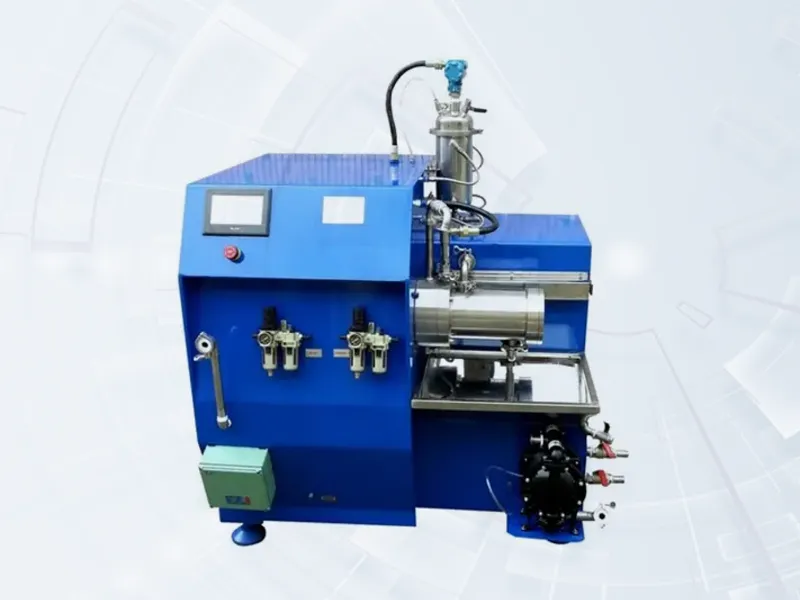
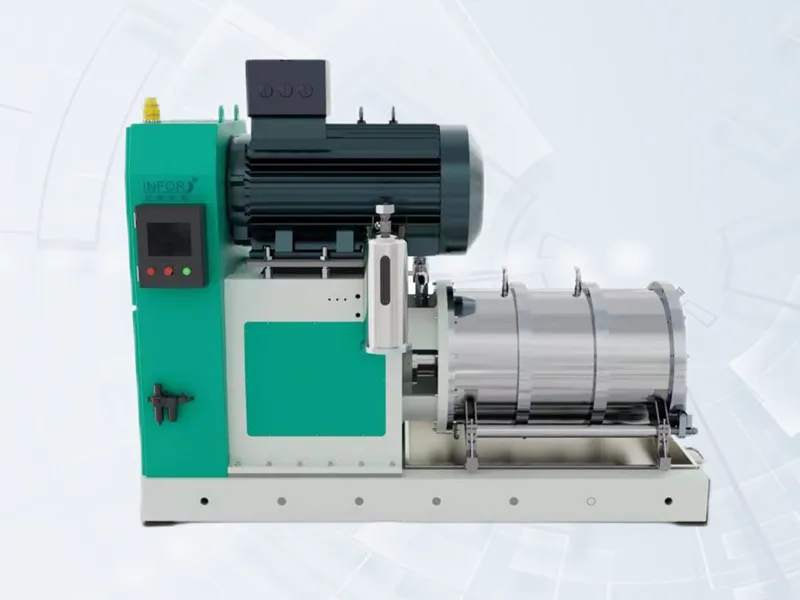
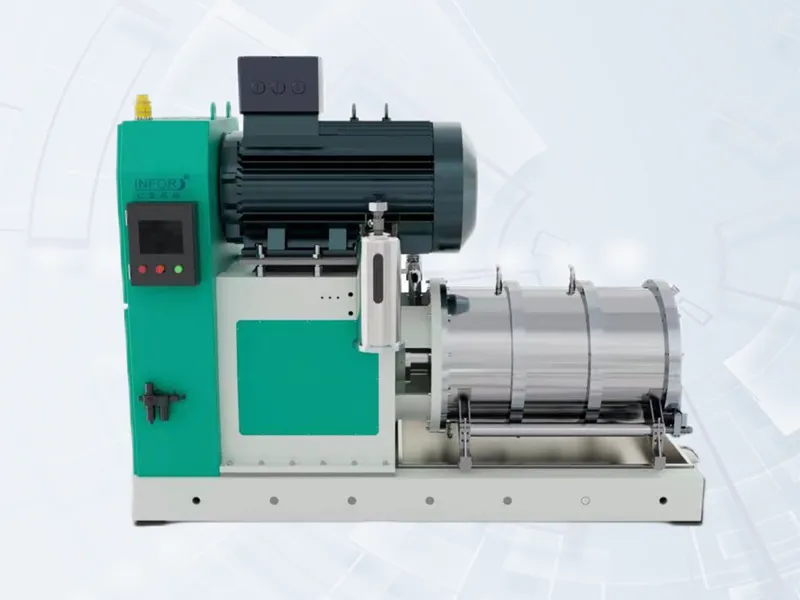
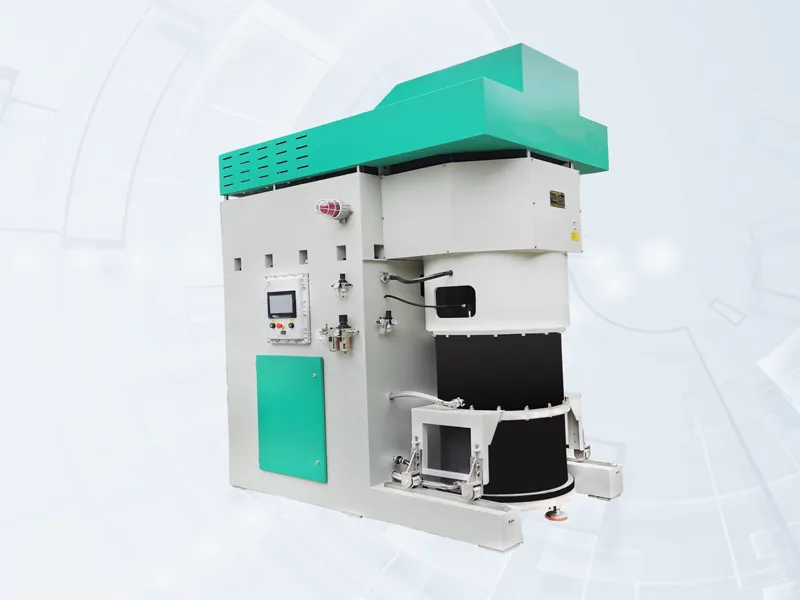
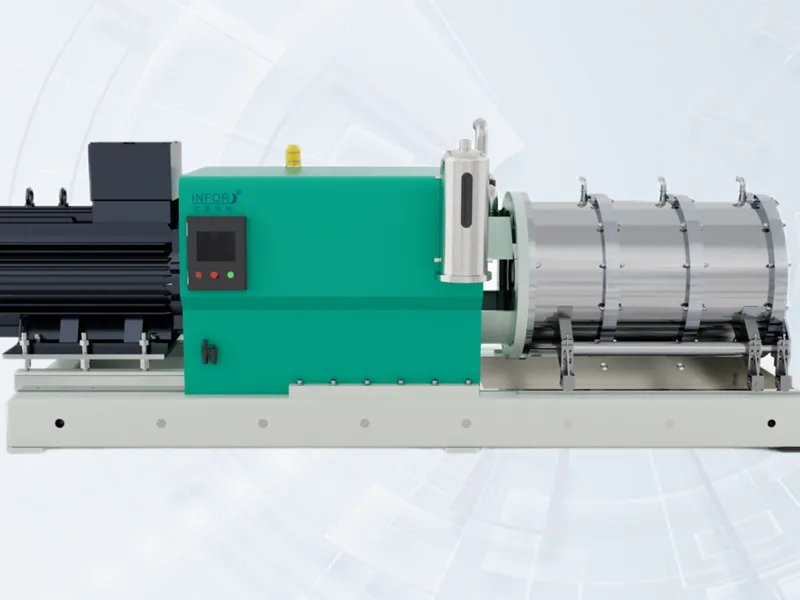
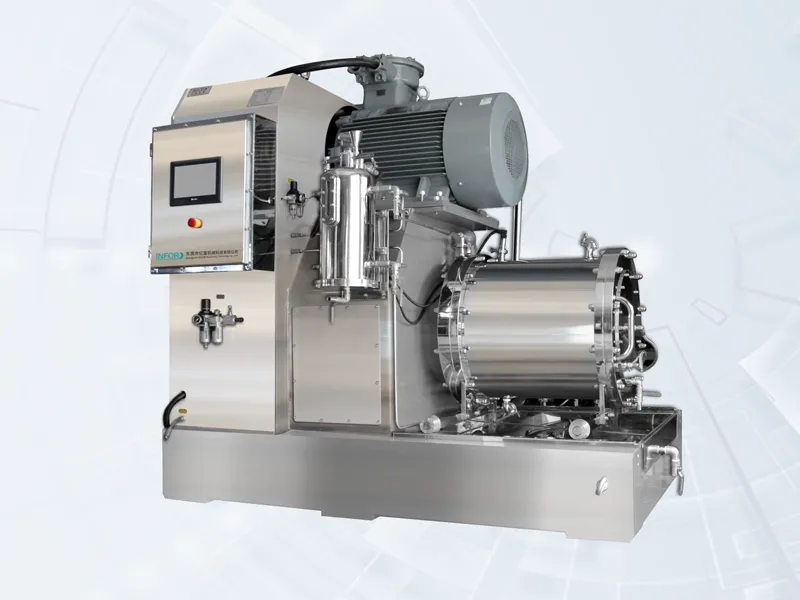
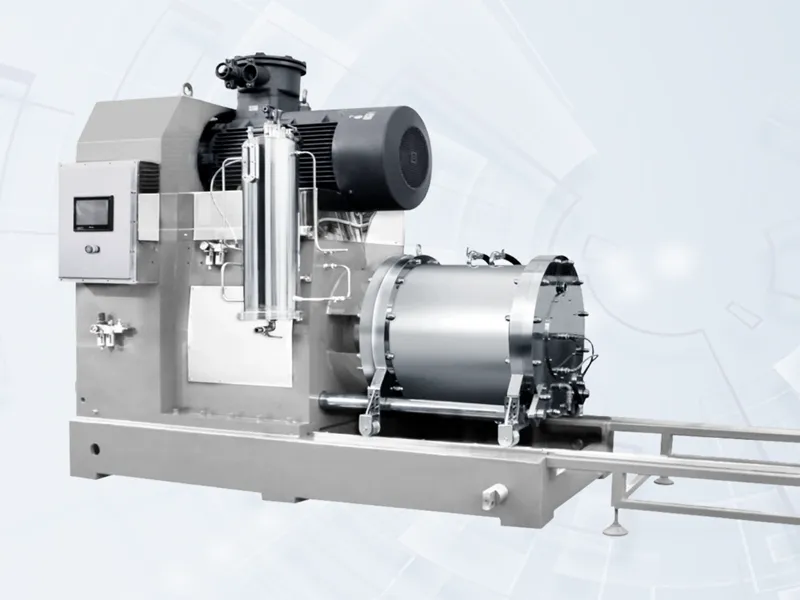

Every battery engineer knows the frustration. You have a promising silicon-carbon anode formulation on paper. In theory, it should boost energy density by leaps. Then you hit the grinding step — and suddenly you are dealing with clogged screens, metal contamination, and inconsistent particle sizes that make scaling to commercial production feel like a distant dream.
This is not just a hypothetical scenario. It is the daily reality for many battery material manufacturers, and it is why dual-power sand mills are quietly reshaping how the industry approaches nano-scale grinding.
To understand why grinding silicon-carbon anode materials is so difficult, you need to look at what happens inside a conventional sand mill.
A traditional horizontal bead mill uses a single motor to drive both the grinding rotor and the separation system. This works fine for many applications — coatings, inks, general chemicals — where the target particle size sits comfortably in the micron or sub-micron range. But silicon-carbon anodes are a different beast entirely.
The material is hard. It is brittle. It demands particle sizes below 100 nanometers to function properly — because that is the scale at which silicon's notorious volume expansion problem can be effectively mitigated. Grinding silicon particles to that fineness significantly improves the material's cycling stability.
When you push a traditional mill toward these targets, several things start going wrong. The high energy input generates excessive heat, and without adequate cooling, the material can sinter or degrade. The screen-based separation system — the standard approach in most conventional designs — begins to clog as grinding media gets smaller. If you try to compensate by using finer screens, you risk media leakage. If you do not, you cannot achieve the target particle size.
The result? Production bottlenecks, inconsistent batches, and too much rejected material. For manufacturers trying to meet the growing demand from battery gigafactories, this is simply not sustainable.
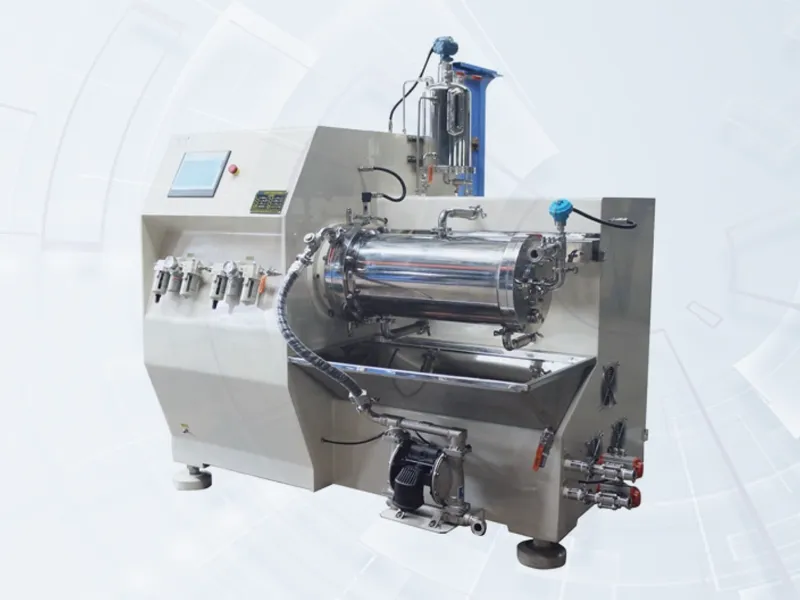
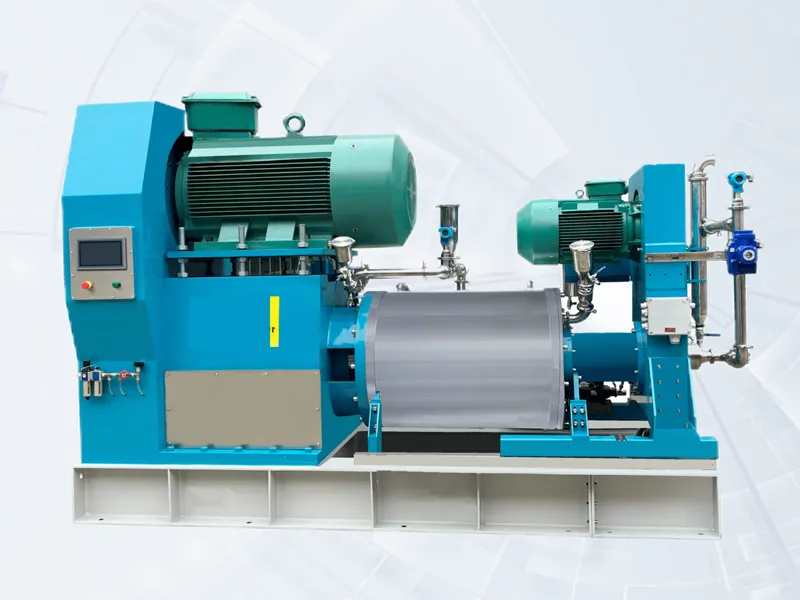
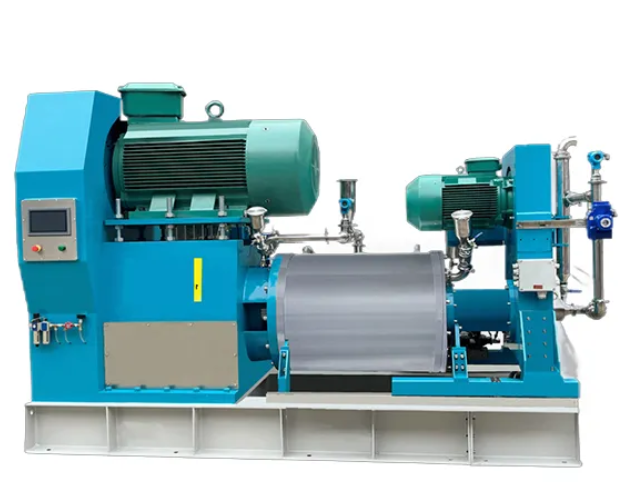
The dual-power sand mill addresses these problems with one fundamental design change: it splits the grinding function and the separation function into two independently driven systems.
In practical terms, this means the grinding rotor and the centrifugal separator each have their own motor. They run at different speeds. They can be adjusted independently. The operator can fine-tune grinding intensity without compromising separation performance — or vice versa.
Why does this matter? Because it lets you use much smaller grinding media than a conventional mill can handle. A traditional screen-based mill struggles with media below 0.2 mm or so. A dual-power centrifugal mill can run stably with zirconium oxide beads as small as 0.05 mm. Smaller media means more contact points per unit volume, which means faster grinding and a narrower particle size distribution.
The separation mechanism itself is also different. Instead of relying on a physical screen that can clog or wear out, a centrifugal separation system uses rotational force to separate the slurry from the grinding beads. No screen means no clogging. No screen means no media leakage. For production managers who have spent too many hours troubleshooting blocked mills, this alone is a compelling selling point.
Heat is the silent enemy of nano-grinding. When you are applying enough mechanical energy to break particles down to the sub-100-nanometer range, the grinding chamber naturally heats up. If that heat is not managed properly, it can change the material's properties — something that is especially problematic for battery materials where purity and crystalline structure matter.
Dual-power sand mills typically incorporate jacketed cooling systems that circulate coolant around the grinding chamber. This is not unique to dual-power designs, but the independent drive configuration means the separator is not generating unnecessary frictional heat, which gives the cooling system less work to do.
For silicon-carbon anode producers, this thermal stability translates directly into batch consistency. You can run the mill for longer periods without the particle size drifting, which is exactly what you need when you are shipping material to a battery manufacturer with tight specifications.
There is another challenge specific to battery materials that is easy to overlook: metal contamination. When grinding media or chamber walls wear down, tiny metal particles can end up in the slurry. In paint or ink, this might cause a slight color shift. In a lithium-ion battery anode, metal contamination can cause micro-shorts, capacity fade, or worse.
This is why leading dual-power sand mills use all-ceramic grinding chamber designs — ceramic rotors, ceramic liners, ceramic pins. Materials like zirconia and silicon carbide offer excellent wear resistance without introducing metallic impurities into the product. For manufacturers working on high-purity applications, this is not a luxury feature. It is a basic requirement.
While silicon-carbon anodes are getting much of the attention right now, the same grinding challenges appear across a surprisingly wide range of high-end materials.
Graphene and carbon nanotube dispersions require similar nano-scale grinding with strict contamination control. Ceramic nitride materials and nano polishing fluids demand narrow particle size distributions. Catalyst materials need high surface areas that only ultra-fine grinding can deliver. Even some advanced coatings and electronic-grade materials are now pushing into particle size ranges that were considered experimental just a few years ago.
The common thread across all of these applications is the same: traditional single-drive sand mills hit a wall when you try to combine ultra-fine grinding media with reliable separation and consistent throughput. The dual-power approach — independent grinding and separation, centrifugal discharge, all-ceramic construction — is becoming the standard answer to this universal problem.
If you are currently sourcing grinding equipment for nano-scale production, here are a few practical points to keep in mind.
Verify the minimum grinding media size the system can handle. Not every machine that claims to be a dual-power mill can actually run 0.05 mm beads stably. Ask for test data. Better yet, send your own material for a trial run.
Look at the cooling system design. Jacketed cooling is one thing.Effective cooling that maintains temperature stability over hours of continuous operation is another. Ask about temperature rise under full load.
Consider the real cost of downtime. A machine that costs less up front but requires frequent screen replacements and cleaning cycles may end up costing far more over its lifetime. For nano-scale production, reliability matters more than the purchase price.
Think about scalability. The ideal situation is finding a supplier who can provide equipment across the range — from lab-scale units for formulation development to full production systems. Consistent geometry and operating principles across sizes make scale-up far less painful than it otherwise would be.Partnering with a reliable sand mill company ensures that your production needs are met consistently, whether for small-scale trials or full industrial throughput.
The transition from conventional to dual-power sand mill technology is not just about buying a newer machine. It is about acknowledging that nano-scale grinding is fundamentally different from the micron-scale grinding that the industry has been doing for decades. The materials are harder. The tolerances are tighter. The consequences of contamination are more severe. And the market — driven by the relentless push for higher battery energy density — is not waiting for anyone to catch up.
For manufacturers who are serious about competing in high-end battery materials, advanced coatings, or specialty nano-materials, advanced nano grinding machine solutions are no longer a niche option. They are rapidly becoming the baseline expectation.
Q: How does a dual-power sand mill differ from a conventional bead mill?
A: The key difference is that a dual-power sand mill uses two independent drive systems — one for the grinding rotor and one for the centrifugal separator — rather than powering both functions with a single motor. This allows each system to operate at its optimal speed, enabling the use of much finer grinding media (down to 0.05 mm) and eliminating the clogging and media leakage problems common in screen-based conventional mills.
Q: What industries benefit most from dual-power nano sand mills?
A: The primary beneficiaries are industries that require ultra-fine grinding with strict contamination control. Battery material manufacturing — particularly silicon-carbon anodes, lithium iron phosphate, and other cathode materials — is the largest current market. Other significant applications include graphene and carbon nanotube dispersion, ceramic nitride processing, nano polishing fluids, high-end inkjet inks, electronic-grade coatings, and catalyst materials.
Q: Why is an all-ceramic grinding chamber important for battery material production?
A: Battery materials are extremely sensitive to metallic contamination. Even trace amounts of metal particles introduced through wear on grinding chamber walls or rotors can cause micro-shorts, capacity fade, and safety risks in finished cells. All-ceramic chambers — typically made from zirconia or silicon carbide — provide the necessary wear resistance without introducing metallic impurities, making them essential for producing battery-grade materials.